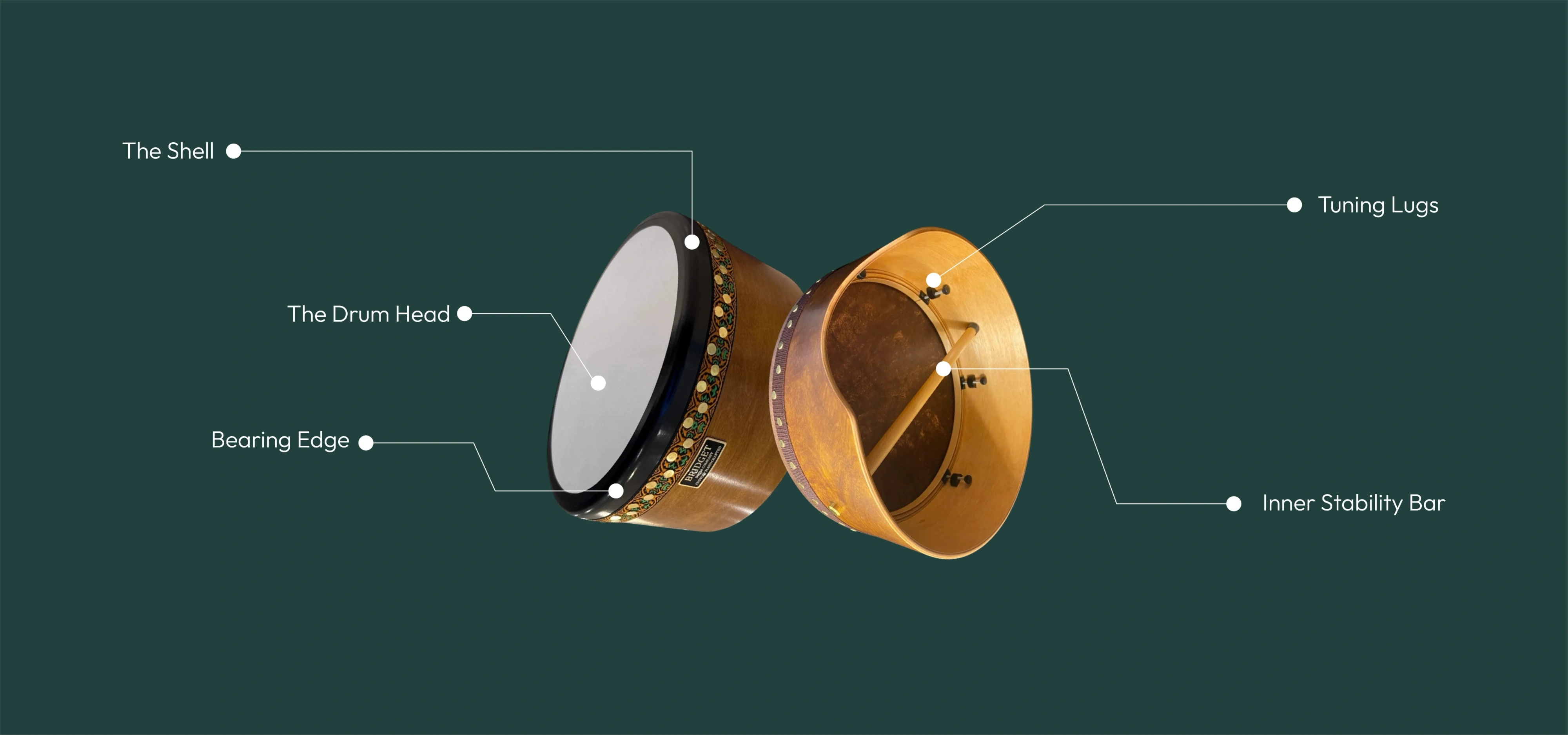
Our bodhrans are built to last, starting with a premium veneered shell designed for maximum strength and resistance to warping. Each bodhran drum features an aircraft-grade aluminum tuning system, combining feather-light durability with precise tuning. Choose between a natural or chemically treated goat skin head, each carefully finished with a rounded bearing edge that protects the skin while delivering a rich, warm tone.
Every model reflects the same meticulous craftsmanship and high-quality materials, yet comes in a variety of sizes and colours to suit your style. Whether you’re a beginner or a seasoned player seeking a professional bodhran, our drums are designed to inspire and perform.
Order Your Very Own Custom Bodhran

There are many options when it comes to drums, but 14” diameter and up to 20” diameter tend to be the most popular. The bigger the drum, the bigger the sound. There are also depth options, and I have found that anything deeper than 6” is a waste of your hard-earned money. If you want that big sound and are smaller in stature, or you have a shorter arm span, you have the option of an arm cut out from the shell. This allows you to get a larger size drum without compromising comfort.
A steam-bent shell is made from one or two plies, glued with a scarf joint where the ends meet. This is a poor option due to the risk of the joint breaking, and the wood’s strong tendency to warp as it tries to return to its original shape.
A stave shell is made from multiple pieces of wood glued together. The problem with staves is that they are often very thick and heavy. While suitable for snare drums, congas, and similar instruments, they are not ideal for a bodhran.
A veneered shell is the best choice for a bodhran because of its strength and stability. The wood grains should be glued in alternating directions; otherwise, the shell may warp.
Wood options include hardwood, exotic wood, and softwood. Hardwood is ideal for strength and durability. Exotic hardwood looks beautiful but can be expensive. Softwood is weaker and prone to dents. Birch and maple are cost-effective, strong options, and if you want an exotic finish, a single veneer can provide it.
There are two main options for the drum head: natural or chemically treated goat skin.
Natural skins are stiffer and require a long break-in period, gradually developing a warmer tone over time. Chemically treated skins, however, are generally superior; they are softer, produce a warmer sound immediately, resist humidity, and are more tear-resistant. We offer both options on our drums, allowing you to choose the head that best suits your playing style.
When it comes to inner stability bars, there are typically a few options, including a straight bar or no bar at all.
I personally prefer a straight bar that is round and no thicker than ¾”. The distance between the bar and the drum head is usually standardized to ensure it doesn’t interfere with the player’s hand.
There are many options when it comes to drums with a tuning mechanism, and a variety of materials are used, including wood, which is actually a poor choice for a tuning system. The best option is a metal, such as aircraft-grade aluminum, which is both extremely strong and lightweight (and what we use on our drums).
The tuning lugs should be rounded with no sharp edges. The two most popular types of tuners are thumb tuners and Allen key tuners. At Bridget Bodhrans, we offer CAM tuners, which are superior and unique to our drums.
The screws (dog screws) that press on the inner tuning ring should never push directly on the wood, as they can quickly damage it. Instead, the screw should rest on a flat plate. A word of caution: some builders use local metal currency as these plates, but defacing or destroying currency is illegal and could cause problems.
Finally, while some builders paint their tuning lugs, I prefer powder coating, which is far stronger and more durable than paint.
The two most popular bearing edges (where the drum head meets the shell) are a chamfer and a rounded edge.
A chamfer edge tends to be sharper and could cut the head. The rounded edge is much safer on the head and tends to make the drum warmer in sound (which we use on our drums).
When it comes to cost, there are many options, but remember, you get what you pay for. Avoid mass-produced, low-quality drums that often sound better in the box than in your hands. Steer clear of drums with logo paintings on the head, as these are usually decorative pieces meant to hang on the wall, not for serious playing.
A skilled builder should craft a drum to suit your individual needs. After all, would you rather wear a tailored outfit made for someone else or one made just for you?
We hope this guide helps, and if you have any questions, don’t hesitate to contact us. After all, “We Build The Art Of Bodhrans.”