
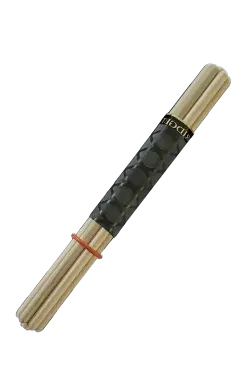
The iconic Irish frame drum, the bodhrán, revolutionised the music scene centuries ago. This instrument’s versatility and expressiveness stem from its varied tools and accessories. Few of its tools are as crucial as the tipper. The tipper is not just a stick; it is a bridge between intention and sound.
Among the variety of tippers, the double-end bodhrán Tipper is the most widely used and the first choice for most musicians.
The double-end bodhrán Tipper is renowned for its expressiveness and responsiveness when mastered correctly. Using it demands technique and discipline; with these, the rhythmic precision and fluid movement can be achieved with unmatched responsiveness. Learn the mechanics and master control to transform your role from a simple rhythm player into an expressive musician.
What is a Double-End Bodhrán Tipper?
With striking surfaces at both ends, a double-end bodhrán Tipper is a short, symmetrical stick. It is played in a continuous back-and-forth motion, generating an effortless, uninterrupted stream of notes. This symmetry enables speed. The player doesn’t need to lift the tipper for each strike; instead, a pendulum-like movement is created by guiding it in a controlled swing.
This efficiency makes it perfectly suited for environments where consistency and tempo are essential.
Key Features:
Double Striking End:
The dual active ends of the tipper facilitate rapid and rhythmic motion.
Length & Balance:
The dual-end bodhrán tipper is usually shorter in length than the single-ended tipper to allow agile movements. It is evenly weighted to create balance. This balance is critical for maintaining control at higher speeds and ensuring that both ends produce a consistent tone.
Material Choice:
Modern options like carbon fibre and hybrid blends offer great durability. However, all in all, wood is the best choice for the natural feel and the traditional resonance.
Responsiveness Level:
Compared to the softer feel of rod tippers, solid construction delivers a snappier bounce, which is essential for executing fast, crisp rhythms.
Built for Speed:
The hallmark of the double-ended tipper is its capacity for rapid play. The design facilitates compact motion, eliminating the need for resetting again and again.
Speed without Sacrifice:
Good technique lets you play fast while keeping every note sharp. Over time, the movement feels automatic, leaving your mind free to think about the rhythm instead of the mechanics.
Accuracy First:
While speed is exciting, it should never undermine your accuracy. Beginners often rush, which leads to unstable timing and sloppy habits. True expertise is found in perfecting your precision at slow speeds before gradually pushing the tempo.
Control: The Core Skill
Control defines a skilled player; speed alone is meaningless. The double-end bodhrán tipper excels at balancing both.
Mastering the Hold:
A secure grip allows the tipper to move freely, conversely a hold that is too loose or too firm leads to loss of control or restricted motion.
Tonal Versatility:
Control also means managing volume by moving from whisper-soft ghost notes to thunderous accents without breaking the flow.
Wrist over Arm:
Control lies in the wrist movement; the arm remains steady.
The Point of Impact:
Tonal variety is found in the angle of attack. Striking with a flat angle keeps the sound soft, while hitting the head directly makes your accents pop with clarity.
The Playing Techniques
There is more to explore with the double-end tipper once you master the playing techniques. It is more than just moving back and forth.
The following techniques are essential for every player, from beginner to expert:
Basic Alternating Stroke:
This is the core technique. The tipper moves in a steady back-and-forth motion, striking the drumhead with each end. Consistency is key here. Focus on even spacing and balanced sound.
The Triplets:
Once comfortable with basic strokes, players can introduce faster groupings such as triplets, i.e., quick three-note bursts. This adds flair and syncopation. This requires tighter wrist control and a clear sense of timing.
Tone Control and Damping:
The hand inside the drum is just as important as the one holding the stick. Pressing against the skin lets you change the drum’s pitch and stop the ringing, giving you much more control over the sound.
Cross Rhythm:
Switching ends mid-pattern allows for polyrhythmic textures.
Accent Control:
When you highlight certain notes, you move beyond just keeping time and start creating a real groove.
Ghost Control:
Subtle, muted strokes fill space without overpowering the melody.
Common Pitfalls:
Many players struggle with the double-ended tipper, not because it is difficult, but because of small technical errors.
The most common issue is over-gripping. It limits movement and quickly leads to fatigue. Another mistake is relying too much on the arm instead of the wrist, which reduces both speed and control.
Inconsistent stroke balance is also a problem. If one end strikes harder than the other, the rhythm becomes uneven. Practising slowly and focusing on symmetry can help correct this.
Practical Applications:
Live Performance:
The rapid tipper movement adds visual flair in energetic performances.
Advanced Practice:
It is an ideal training tool and a great way to improve, because of the challenge it poses for users, embracing it bridges the gap between basic mechanics and advanced mastery
Traditional Irish Music:
The double-end bodhrán tipper is a must-have in a traditional music setup, because it makes playing fast, steady rhythms feel so much easier.
The Selection Guide:
Not all tippers are the same, the choice depends on the required style and comfort:
A heavier tipper increases the volume but may slow down the speed.
Lighter ones allow for faster movement but require better control. Length also plays a role. Shorter tippers are easier to handle, while longer ones can offer a broader range of motion.
The shape of the ends affects tone as well. Rounded ends produce a softer sound, while more defined edges create sharper attacks.
Trying different options is often the best way to find what suits you.
Final Takeaway:
The double-end bodhrán tipper is a gateway to speed, innovation and control. As a beginner, it feels challenging, but with practice, it becomes an extension of the hand.
For seasoned musicians, it is more than a tool for putting captivating energy and enthusiasm into the whole environment.
While the single-end bodhrán rod tipper is for precision, the double-end bodhrán tipper is the ultimate pick for exhilarating beats.