
The Science Behind a Bridget Bodhrán

Russel Duke

The science behind Bridget Bodhrán drums starts with carefully selected materials and thoughtful design choices that shape the instrument’s sound and playing response.

The wood used for the shell, its layered construction, the bearing edge, tuning system, goatskin head, hardware and outer banding all influence how the instrument performs.

At Bridget Bodhrán, these elements work together to create a lightweight, responsive instrument capable of producing the deep, powerful sound associated with a quality Irish bodhrán.

Every component serves a purpose in the design and construction of a Bridget bodhrán.

Why Do Bridget Bodhrans Use Multi-Layer Canadian Rock Maple?

multi-layer Canadian rock maple

The shell is the foundation of the instrument. Bridget Bodhrans use select-grade Northern Hard Rock Maple in a multi-layer construction. Maple offers a strong, rigid foundation, while the cross-layer construction helps improve dimensional stability and resistance to movement in the shell.

The result is a shell designed to handle head tension while providing an efficient foundation for the drumhead to respond to the player’s strokes.

1. Structural Stability

Hard Rock Maple is a dense, strong hardwood. When multiple layers are bonded with their grain directions arranged across the shell, the construction provides greater dimensional stability than a single piece of wood.

For a bodhrán, stability matters. The shell needs to maintain its shape while the head is held under tension and the instrument is played repeatedly.

2. Controlled Resonance

The shell influences how energy from the drumhead is reflected and absorbed.

The multi-layer maple construction is part of Bridget’s approach to achieving a controlled response rather than an excessively loose or uncontrolled resonance. The goal is a full low-end response while retaining enough definition for faster playing techniques.

3. Clear Note Definition

A deep bass tone is only useful if the player can still hear the detail in the rest of the instrument.

The combination of the maple shell and the other components in drum frames are designed to provide a strong low-end foundation while maintaining definition in the mid and higher ranges. This helps bass notes, rolls, taps and finger techniques remain distinguishable during playing. Discover Bridget Bodhrán’s built with carefully selected materials, purpose-driven construction and a focus on sound, response and playability.

Why Does Bridget Bodhrán Have a Rounded Bearing Edge?

The bearing edge is the point where the drumhead meets the wooden shell. Its shape affects how the head sits against the shell and how the instrument responds to playing and tuning. 

Bridget uses a rounded bearing edge rather than the sharper profiles commonly associated with many modern drum kits.

This choice reflects the unique requirements of a bodhrán, particularly its natural goatskin head and the player’s use of hand pressure to change pitch and tone.

Rounded bearing edge drum frames

Supporting a Warm, Natural Response

A bodhrán is not played like a conventional drum kit. The player can place the non-dominant hand against the inside of the goatskin and vary the pressure while playing. This changes the tension of the head and allows the player to bend pitch and shape individual notes. A rounded edge provides a smooth transition between the shell and the natural skin. Bridget’s design aims to support a warm, controlled response that complements this playing technique.
Natural goatskin behaves differently from synthetic drumheads. It responds to tension, pressure, temperature and humidity, and it needs to move naturally against the shell during tuning and playing. The rounded bearing edge provides a smooth contact surface for the skin while helping protect the head from harsh contact with a sharp wooden edge.
Hand-pressure tuning is one of the defining features of modern bodhrán playing. When the player presses against the inside of the head, the skin changes tension and the pitch moves with it. Bridget’s rounded edge is designed to allow this interaction to feel smooth and natural rather than restricting the movement of the skin around the edge.

Why Doesn't Bridget Use a Fixed Inner Reinforcement Ring?

Some drums use fixed reinforcement rings to increase stiffness around the shell.

Bridget takes a different approach.

Rather than permanently gluing a thick reinforcement or tuner ring to the inside of the shell, Bridget uses a multi-layer outer shell together with an independent, free-floating inner tuning ring.

The goal is to provide the structural support required for the tuning system while preserving the open response of the instrument.

Keeping the Shell Design Open

Adding substantial material around the inside edge of a drum changes its mass and stiffness. Because a bodhrán has an open back and relies heavily on the interaction between its head, shell and internal air volume, Bridget’s design avoids adding a permanently fixed, heavy structure directly around the inner edge. The free-floating approach allows the tuning system to perform its structural role without making the inner shell a permanently reinforced, rigid structure.

Supporting the Low-End Response

The deep bass response of a bodhrán depends on the interaction of the head, shell and air inside the handmade Irish frame drums.

Bridget’s construction is designed to maintain that open, low-frequency character while providing the stability needed for modern tuning.

Rather than treating the tuning system as a separate component, the design considers the shell and tuning system as parts of the same acoustic structure.

Why Does Bridget Use Lightweight Aluminum Tuning Hardware

Weight matters on a bodhrán. Players often hold the instrument with one arm for an entire performance, so unnecessary weight can quickly become noticeable.

Bridget uses lightweight aluminum tuning hardware, including lugs and flat plates, to provide the required mechanical strength without adding unnecessary mass.

1. Lower Overall Weight

Aluminum allows Bridget to reduce hardware weight while maintaining a rigid and precise tuning system. For players who perform for long periods, reducing the weight of the instrument can make it more comfortable to hold.
The tuning hardware must withstand repeated adjustment while maintaining consistent tension around the head. Precision-machined aluminum components provide a rigid platform for the tuning system and can be paired with precision threads to allow controlled, incremental adjustments.
Bodhráns are handled frequently and can encounter humidity, perspiration and changing environmental conditions. Aluminum is naturally corrosion resistant, making it well suited to hardware that is repeatedly handled and adjusted.
Every component attached to a drum contributes some amount of mass. By using lightweight hardware, Bridget can maintain the structural requirements of the tuning system without unnecessarily weighing down the shell.

Why Are Bridget Bodhrán Heads Made From Treated Goatskin?

Natural goatskin is an important part of the traditional character of a bodhrán.

However, natural skin can vary in thickness, texture and response. It can also react noticeably to changes in humidity and temperature.

Bridget treats its goatskin heads to produce a more consistent playing surface and help the skin perform reliably under everyday playing conditions.

premium goat skin

1. Consistent Playing Response

Untreated natural skin can require a period of playing before it settles into the response a player expects.

Bridget’s treatment process is designed to produce a softer, more playable head while retaining the natural characteristics of goatskin.

Natural skin responds to moisture in the surrounding environment.

High humidity can cause a head to loosen, while very dry conditions can cause it to tighten. No natural skin is completely unaffected by the environment, but treatment can help reduce the severity of these changes and provide a more consistent playing experience.

A bodhrán head experiences repeated impact from the tipper as well as continuous contact with the player’s hand.

Bridget’s skin preparation is designed to improve the head’s durability while maintaining the flexibility required for hand-pressure playing.

Natural hides can contain variations in texture and thickness.

Bridget processes its heads to create a smoother, more consistent surface for the player and tipper.

What Is the Nano Treatment on a Bridget Bodhrán Head?

Bridget also uses a nano treatment as part of its goatskin head preparation. The purpose of the treatment is to help manage the interaction between the skin and its environment while maintaining the natural flexibility and acoustic character of the hide.

Moisture Resistance

Goatskin is naturally porous and can absorb moisture from the air, hands and surrounding environment. The nano treatment is designed to reduce moisture absorption at the surface, helping the head maintain a more consistent response as environmental conditions change.

Helping Prevent Mould Growth

Moisture can create conditions that encourage mould growth on natural goatskin, particularly when a bodhrán is stored in a damp environment. Bridget’s nano treatment helps reduce moisture absorption at the skin’s surface, adding another layer of protection against dampness and helping prevent mould growth.

For players, this is a practical benefit that can help protect the condition of the goatskin head, particularly in humid conditions. However, the treatment does not make the head mould-proof. Proper drying, ventilation and storage remain important.

Maintaining the Character of Natural Skin

A natural goatskin head needs to remain flexible. The objective of the treatment is not to turn the skin into a rigid synthetic surface. It is to provide additional protection while retaining the natural feel and response that make goatskin such an important part of the bodhrán.

Protection During Playing

The player’s hand repeatedly contacts the inside of the head. Over time, sweat, oils and dirt can accumulate on natural skin. The treatment helps make the surface easier to maintain and can provide additional resistance to everyday contamination. For best results, however, the head should still be handled and stored properly.

Nano Treatment on a Bridget Bodhrán Head

Why Do Bridget Bodhrans Have Colored Poly Banding?

The colored band around a Bridget bodhrán serves more than a visual purpose.

Bridget uses banding as part of its approach to controlling unwanted high-frequency resonance around the outer area of the drumhead.
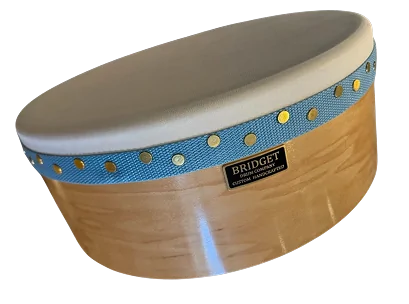
Controlling Unwanted Ring

Colored Poly BandingWhen a drumhead vibrates, different areas of the membrane contribute to the overall sound.

Excessive high-frequency resonance around the edge can create a longer, more noticeable ring. The banding helps control some of this response.

The aim is a tighter, more focused sound with less unwanted ringing.

Supporting the Fundamental Tone

Reducing excessive high-frequency resonance can allow the fundamental character of the drum to become more prominent.

For a bodhrán, that means emphasizing the deep, punchy response players often look for rather than allowing excessive ring to dominate the sound.

Useful for Amplified Performance

Bodhráns are often used in live performances and recording environments where microphones capture the instrument at close range.

A controlled response can make it easier to capture the drum’s fundamental sound without excessive ringing competing with other frequencies in the recording or live mix.

And, of course, the banding also gives each Bridget bodhrán its distinctive visual character.

How All These Elements Work Together

There is no single component responsible for the sound of a bodhrán. The shell, bearing edge, tuning system, goatskin, hardware and banding all influence the way the instrument feels and responds.

Bridget’s approach is to consider these components as one system.

  • The multi-layer Canadian Rock Maple provides the shell foundation. 
  • The rounded bearing edge works with the natural goatskin head. 
  • The free-floating tuning ring provides structural support without permanently reinforcing the inner shell. 
  • Lightweight aluminum hardware supports precise tuning without adding unnecessary weight. 
  • Treated goatskin provides a consistent playing surface, while the nano treatment helps manage moisture and offers an added layer of protection against mould. 
  • The colored banding helps control unwanted resonance while contributing to the instrument’s distinctive appearance.

The result is an instrument built around a simple idea: Every component should have a purpose.

↑